LED strip dimmer: comfortable brightness control
LED strips are a popular lighting option in both home and commercial interiors. They are versatile, durable and energy efficient. But to achieve maximum comfort and flexibility in lighting control, it is worth installing a dimmer for the LED strip. This device allows you to adjust the brightness of the lighting, adapting the light to your mood, task or time of day.
What is a dimmer and why is it needed?
A dimmer is an electronic device that regulates the power supply to a light source, changing its brightness. In the case of LED strips, the dimmer controls the voltage or pulse-width modulation (PWM) to change the intensity of the diodes.
Advantages of using a dimmer:
- Ability to set a comfortable level of lighting;
- Saving energy with reduced brightness;
- Increasing the service life of the strip when operating at reduced power;
- Aesthetics and atmosphere - from bright white light to soft subdued lighting.
What types of dimmers are there for LED strips?
The choice of dimmer depends on the type of strip, power, control method and tasks. Main types:
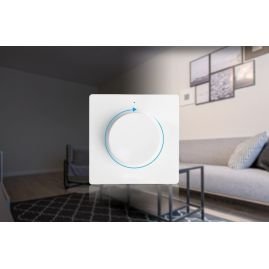
1. Mechanical (rotary, push-button)
These are the simplest devices installed in the wall, like a regular switch. Control is manual:
- Turn the knob;
- Press the key.
Suitable for single-color 12V and/or 24V strips. Do not require complex settings, convenient in everyday life.
2. Touch dimmers (sensors)
Often integrated into furniture or mirrors. React to the touch of a finger. Suitable for decorative lighting:
- Kitchen sets;
- Mirrors;
- Cabinets.
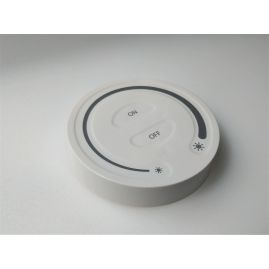
3. Remote control dimmers (radio, IR)
Controlled by remote control:
- Radio frequency (RF) works through walls;
- Infrared (IR) requires direct visibility. (outdated technology is no longer produced)
Often used in areas where the tape is hidden or difficult to access.
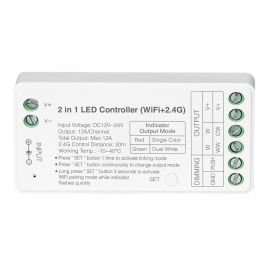
4. Wi-Fi and Bluetooth dimmers
Innovative solutions for smart home:
- Control via smartphone or voice assistant (Google, Alexa);
- Ability to create scenarios, timers, modes on a schedule.
Suitable for modern "Smart Home" systems.
5. Dimmers for SST (DW / WW) LED strips
these are dimmers with two channels for connecting the LED strip. Designed for SST LED strips on which two types of LEDs are installed: warm white glow (2700K) and cold white glow (6500K). The LEDs alternate for uniform mixing of light and have separate power lines on the minus. Thus, the LED strip is connected to the SST dimmer with three wires: Plus and two minuses, dimmer control allows you to adjust the brightness of cold and warm LEDs independently, resulting in the desired color temperature in the range from warm to cold.
This way, you can adjust the brightness and color temperature of the lighting as needed and to suit your mood.
How to connect a dimmer to an LED strip?
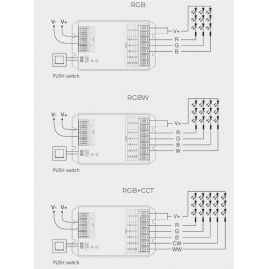
The connection diagram depends on the specific dimmer model, but the general principle is the same:
- The power supply is connected to a 220V network.
- The output of the power supply (12V or 24V DC) is connected to the dimmer input.
- The dimmer output is connected to the strip.
It is important to observe the polarity and power:
- «+» to plus, «–» to minus;
- The dimmer must withstand the current and power of the strip.
If the power of the strip exceeds the capabilities of the dimmer, it is recommended to use a signal amplifier (amplifier).
How to choose a dimmer for LED strip?
When choosing a suitable device, consider several factors:
1. Voltage compatibility
If you have a 12V strip, the dimmer must be designed for this voltage. The same applies to 24V.
2. Maximum power
Calculate the total power of your strip. Make sure that the dimmer can withstand this load. It is better to choose a model with a reserve of 20-30%.
3. Strip type
- For a single-color strip, a regular monochrome dimmer is suitable;
- For CCN (DW/WW) - only a special CCT dimmer.
4. Control type
Choose the method that is most convenient for you:
- Wall - if the strip is controlled as the main lighting;
- Remote control or Wi-Fi - if the backlight is installed in hard-to-reach places.
5. Availability of additional functions
Some models support scenarios, timers, music synchronization. This can be a plus for decorative and dynamic lighting.
Advantages of Dimmers from ™”VERSO”
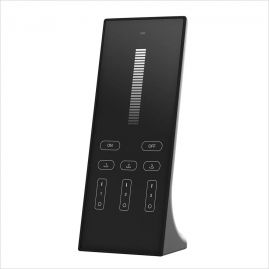
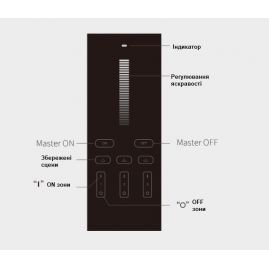
The Touch series LED strip dimmers embody all the most modern technologies in this industry. A full range of options is offered:
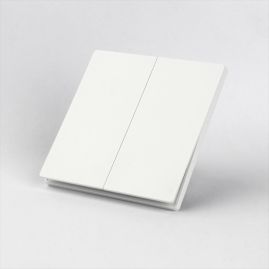
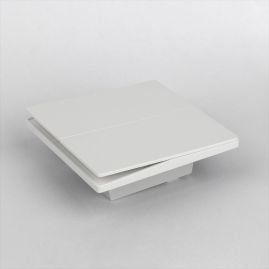
- Wall-mounted dimmers with wired connection.
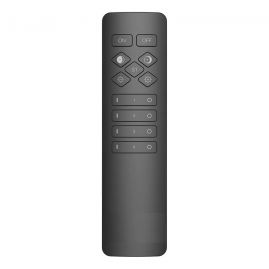
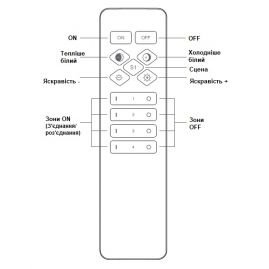
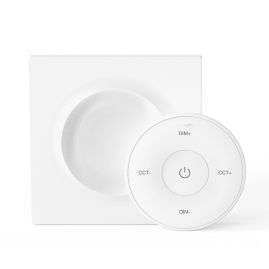
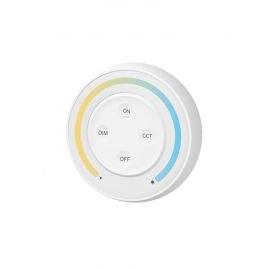
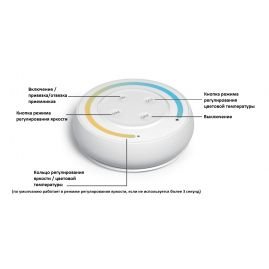
- Dimmers consisting of a dimmer receiver and a remote control.
- Universality of receivers - control of various remote controls
- High-quality radio signal 2.4 Hz operating at a distance of up to 30 m, penetrating well through walls, signal retransmission technology between receivers.
- The presence of both single-zone remote controls and remote controls designed to control several lighting zones, each can have several dimmer receivers.
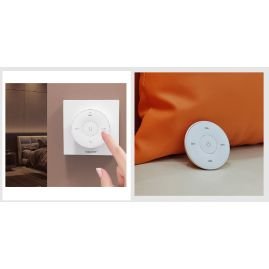
- Various and modern design of remote controls: for stationary installation on walls, on magnetic mounts, tabletop. Various housing colors.
- CCT universal dimmers, allow you to control both monochromatic strips and CCT LED strips with variable color temperature.
Operating tips
- Do not overload the dimmer - always leave a power reserve;
- Install in well-ventilated areas - especially if the power is high;
- Use high-quality power supplies - to eliminate flickering or instability;
- Check compatibility with the strip and power source before purchasing and installing.
Frequently asked questions
Can I use a dimmer from incandescent lamps for an LED strip?
No. Dimmers for incandescent lamps or 220V lights are not suitable - you need a model designed for 12V or 24V DC.
Will the dimmer work without a remote control?
If it is a radio-controlled model - no. However, there are universal units that support both remote control and manual control.
The light flickers when dimming - what to do?
Most likely, the problem is in the incompatibility of the power supply and dimmer, or in their low quality. Use proven brands such as ™”VERSO”.
Conclusion
A dimmer for LED strip is a convenient and functional addition that allows you to control the brightness and create the desired atmosphere in the room. Whether it's cozy bedroom lighting, an accent on interior elements, or flexible work area lighting - with a dimmer, all this becomes possible. The main thing is to choose the right device for the type of tape, voltage, and desired control method.


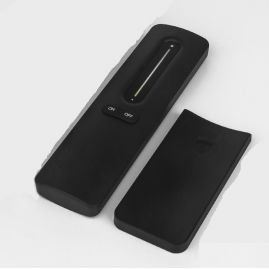

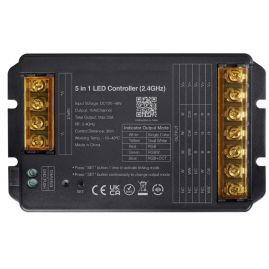
- Load current: 30А
- Load supply voltage: 12-48В
- Number of control channels: RGB (3 channels) RGBW (4 channels) MC(RGBWW)(5 channels) Dim monochromatic CCT
- Series: Touch
- Type: Receiver controller