LED strip with motion sensor and touch dimmer: smart lighting on a new level
Modern lighting technologies are developing rapidly, offering users not only bright and economical light, but also smart control functions. One of the most convenient and functional solutions is an LED strip with a motion sensor and touch dimmer - a compact, stylish and technologically advanced system that makes everyday life easier and more comfortable. In this article, we will analyze how this lighting works, where it can be used and how to choose the right option.
What is an LED strip with motion sensors?
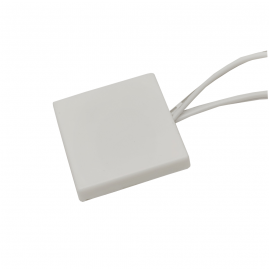
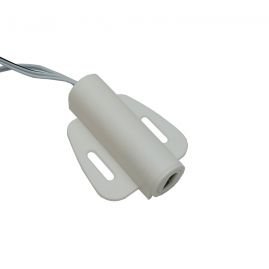
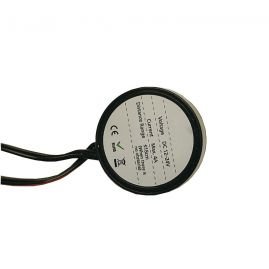
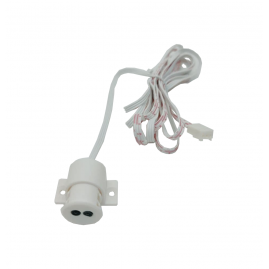
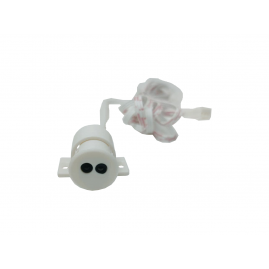
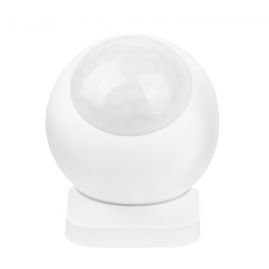
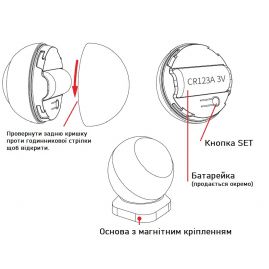
An LED strip with a motion sensor is an LED strip that is automatically turned on by a sensor when motion is detected in the sensor's coverage area. This solution is ideal for places where automatic lighting without using switches is important.
There are various motion sensors. Which turn on the lighting when:
- a person appears in the room
- a hand approaches the sensor
- opening/closing the door
- touching
Operating principle:
- When the sensor is activated, power is supplied to the LED strip;
- The strip lights up for a specified time (usually from 15 seconds to several minutes);
- After no movement — switches off automatically.
This mechanism is especially useful in rooms where your hands are busy or access to the switch is difficult.
Where is this LED strip used?
The versatility of the system with a motion sensor makes it ideal for:
- Lighting cabinets and dressing rooms - when the door is opened, the light turns on automatically;
- Lighting stairs and corridors - safety at night;
- Underbed lighting - comfort upon waking up;
- Lighting kitchens, bathrooms, storage rooms;
- Commercial properties - showcases, shelves, exhibition stands.
The system is especially relevant in homes with children, elderly people or in places where energy efficiency is important.
Touch dimmer: flexible brightness control
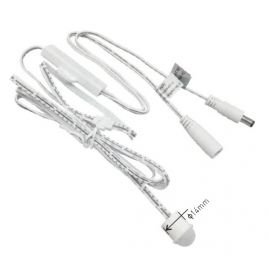
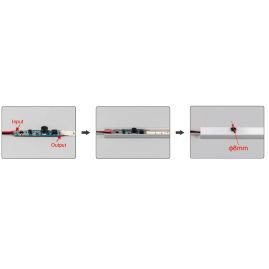
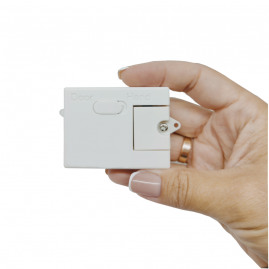
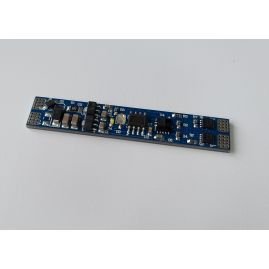
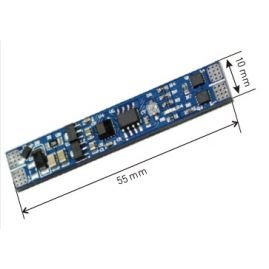
A touch dimmer is an addition to the strip with a sensor - a device that allows you to control the brightness of LEDs with a light touch. It is often built into the profile, the tape body or placed separately.
Sometimes the dimming function is implemented in the sensor itself. In this case, this device usually has a memory function. And the set brightness level is saved when turning the light on and off.
Touch dimmer capabilities:
- Smooth brightness control - from soft glow to full brightness;
- Selected level locks — brightness is maintained the next time you turn it on;
- Compact size and laconic design;
- Some models are equipped with a touch-touch on/off function.
A touch dimmer makes lighting individual and more comfortable.
Advantages of combining a motion sensor and a dimmer
Using two technologies simultaneously opens up new levels of comfort and energy efficiency:
- Automation: the light turns on only when needed — you don't waste electricity.
- Safety: stairs, corridors and dark areas are illuminated immediately when a person appears.
- Individual settings: using a dimmer, you adjust the brightness level for a specific time of day or task.
- Convenience and hygiene: control without buttons or remote controls - movement or touch is enough.
Types of sensors and dimmers
Sensors:
- IR (infrared) - react to body heat. The most common type.
- Microwave - detect movement even through thin partitions.
- Combined - combine different technologies to improve accuracy.
Touch dimmers:
- Capacitive - react to the touch of a finger;
- Inductive - react to the approach of a hand;
How to choose an LED strip with a sensor and dimmer?
When choosing a suitable kit, it is worth paying attention to several key parameters:
1. Type of tape
- 12V or 24V — select all system components (power supply + sensor + strip) by the same voltage;
- Light color — warm, neutral or cold white, RGB;
- Diode density — the more LEDs per meter, the more uniform the light.
2. Sensor parameters
- Angle and radius of action (usually 120–180° and up to 5 meters);
- Off delay time;
- Ability to adjust sensitivity.
3. Dimmer type
- Built-in or remote;
- Control method (touch, wave of hand, proximity);
- Brightness memory support.
4. Package contents
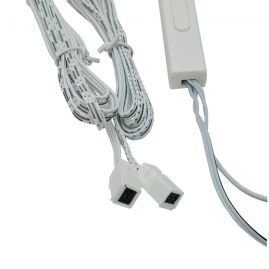
- Some kits come ready to connect: strip, power supply, sensor, dimmer, connectors;
- Make sure you have all the necessary accessories for installation.
Installation tips
- Install the motion sensor at a height of 1-2 meters and point it towards the entrance to the lighting area;
- For the kitchen and closet, it is better to choose built-in models that do not spoil the appearance;
- Do not install sensors near windows — direct sunlight can cause false alarms;
- Check the polarity of the connection - errors can damage the equipment.
Conclusion
LED strip with a motion sensor and touch dimmer - this is an excellent solution for those who value convenience, safety and modern design. Automatic switching on of light, the ability to adjust brightness and no need for switches make such a system ideal for home, office, store and other premises. With minimal costs, you get maximum functionality and comfort.


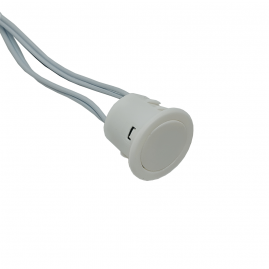
- Load current: wall invoice
- Number of control zones: 1
- Series: Touch