
How to Choose an LED Light for Your Home: A Practical Guide
Modern lighting technologies are rapidly advancing, and today LED lamps have firmly replaced traditional incandescent bulbs. They are energy-efficient, durable, and create a comfortable atmosphere in any room. However, to properly illuminate a room, you need to know how to choose an LED lamp for your home, taking into account the space's size, purpose, and design.
Why choose LED lighting for your apartment?
Choosing LED lighting for your apartment isn't just a fashion trend, but a rational decision. LED lamps offer several advantages:
- Energy saving – consume up to 80% less energy than conventional lamps.
- Durability - service life exceeds 30,000-50,000 hours.
- Safety - does not contain mercury and does not heat up.
- A variety of shades and shapes allows you to select a lamp to suit any interior.
In addition, LED technology allows for flexible control of light—from adjusting brightness to changing the light temperature depending on the time of day.
Basic parameters of LED room lamps
Before purchasing, it's important to understand which parameters of an LED room light really matter:
- Power (W)
To illuminate a 1 m² room, approximately 3-4 watts of LED power is required. For example, a 15 m² room would require a luminaire with a power of approximately 60 watts.
- Luminous flux (lm)
The higher the value, the brighter the lighting. For residential spaces, a comfortable value is between 300 and 500 lm per square meter.
- Color temperature (K)
2700–3000 K – warm white light, creates a cozy atmosphere.
4000 K – neutral white, ideal for kitchens and offices.
5000–6500 K – cool white, suitable for technical areas and bathrooms.
- Color rendering index (CRI)
The recommended value is at least 80 Ra. At this level, the colors of objects will appear natural.
- Light scattering angle
A narrow beam (30–60°) is used for accent lighting, a wide beam (90–120°) for general lighting.
- Housing type and protection (IP)
For a bedroom or living room, IP20 is sufficient, but for the kitchen and bathroom, it is better to choose models with IP44–IP65 protection.
Which LED lamp is best for a bedroom?
The bedroom is a space for rest and rejuvenation, so the lighting should be soft and inviting. To determine which LED light fixture is best for the bedroom, consider the following tips:
- Choose warm lighting – 2700–3000 K, it promotes relaxation.
- Use diffused light - frosted lampshades and fabric shades soften the brightness.
- Add zoning - a ceiling lamp, bedside sconces and decorative lighting create a balance of light.
- Consider dimmable models—the ability to adjust brightness allows you to adapt the lighting to your mood.
- Surface-mounted or recessed panels with a soft glow around the perimeter, creating the effect of "floating" light, are ideal for modern interiors.
Recommendations for choosing LED lighting for different rooms
Living room
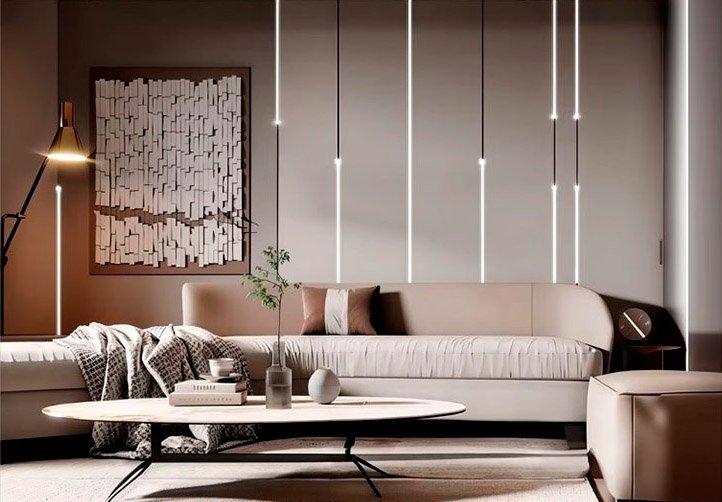
The main sitting area requires versatile lighting. Ceiling fixtures provide the primary lighting, while floor lamps or wall sconces can accentuate specific areas. The optimal temperature is 3000–4000 K.
Kitchen
Functionality is key here. It's best to use cool or neutral white light (4000–5000 K) to ensure good visibility of the work surface.
Bathroom
Requires moisture protection (IP65 or higher). White light (4000–5000 K) is preferred, as it visually makes the space cleaner.
Children's
Choose lamps with a high color rendering index (CRI> 85) and neutral light to avoid eye strain.
Conclusion
Choosing LED lighting for your apartment is a combination of aesthetics and functionality. To ensure your lights provide years of enjoyment, consider their wattage, color temperature, color rendering index, and operating conditions.
Remember: a well-chosen LED lamp for a room creates not only the desired level of illumination, but also an atmosphere of coziness, comfort, and inspiration.