
Keywords: how to choose a power supply for an LED strip, which power supply is needed for a 12V LED strip, calculating the power of a power supply for an LED strip, choosing a transformer for an LED strip at home
How to choose a power supply for an LED strip: tips and calculations
An LED strip is a universal solution for lighting rooms, display cases, and decorative areas. However, without a suitable power source, it simply won't work. A power supply or transformer provides stable voltage and protects the system from overloads. To ensure long-lasting and safe lighting, you need to know how to choose the right power supply for an LED strip, taking into account the wattage, voltage, and operating conditions.
Why do you need a power supply for an LED strip?
LED strips operate on low DC voltage—12 or 24 volts. The grid supplies 220V AC.
The power supply's job is to convert the grid voltage to a voltage safe for the LEDs, ensuring their stable operation.
Besides conversion, the power supply performs several other functions:
- Protects the strip from power surges;
- Prevents overheating and short circuits;
- Extends the life of the LEDs;
- If you choose the wrong power supply, the strip will flicker, overheat, or even fail.
What power supply is needed for a 12V LED strip?
The operating voltage of the LED strip is always indicated on its packaging.
The most common is 12 V, less common is 24 V.
To determine which power supply is needed for a 12 V LED strip, it is important to focus on two parameters:
- Power — how many watts the strip consumes per meter.
- Length — how many meters you plan to connect to one power supply.
If the power supply is rated for 12 V, only strips with the same voltage can be connected to it. Using incompatible equipment (for example, a 24 V strip to a 12 V power supply) will result in incomplete illumination or damage to the components.
Power Supply Power for LED Strips: Calculation
To avoid overload, it is necessary to correctly calculate the power supply.
The formula is simple:
> P = L × W
where:
P is the required power supply (W),
L is the strip length (m),
W is the strip power per meter (W/m).
After this, the result must be multiplied by a safety factor of 1.25-1.3 to prevent the unit from operating at its limit.
Calculation example:
A 12 V strip consumes 9 W/m, its length is 8 m.
9 x 8 = 72 W.
With a safety factor: 72 x 1.25 = 90 W.
This means you need to choose a power supply with a minimum power of 90 W (preferably 100 W).
The extra power extends the life of the power supply and prevents it from overheating.
Types of Power Supplies for LED Strips
There are several types of power supplies on the market. They differ in design, protection level, and installation method.
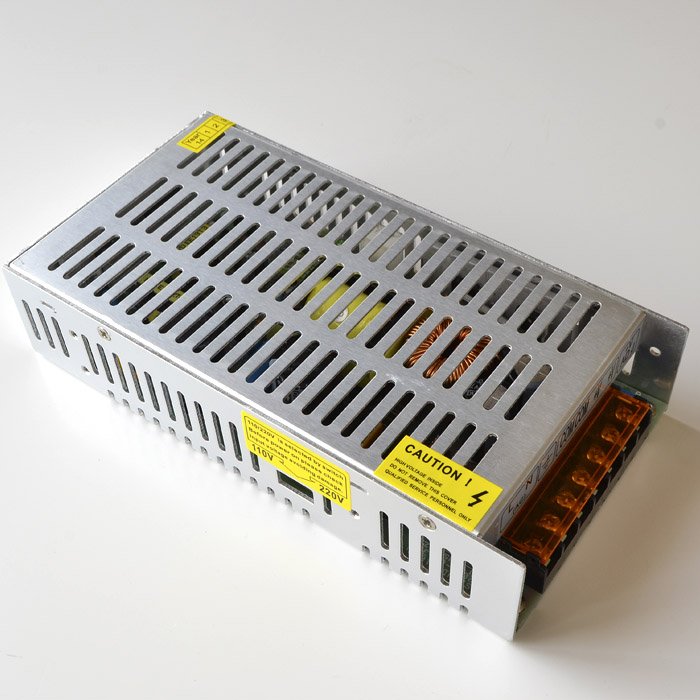
- Open (perforated)
Metal case with ventilation. These units are installed indoors — In cabinets, ceiling niches, or electrical panels.
Advantages: High efficiency, affordable price.
Disadvantage: Not suitable for damp areas.
- Sealed (waterproof)
They have an IP65-IP67 protection rating. The aluminum or plastic housing is completely sealed.
This is an ideal option for installation in the bathroom, kitchen, or outdoors.
Disadvantage: Limited ventilation, so it is important not to exceed the permissible load.
- Adapter (wall-mounted)
They resemble standard laptop power supplies. Suitable for short strips (up to 3-5 m) and decorative furniture lighting.
The main advantage is ease of connection.
How to choose a power supply for an LED strip at home
When choosing a power supply for home use, consider the following criteria:
- Voltage.
Must strictly match the strip voltage (12V or 24V).
- Power.
Calculate using the formula and add 20-30% reserve.
- Casing type.
An open version is suitable for dry rooms, while a closed version is suitable for damp rooms. Sealed.
- Build quality.
A good power supply has built-in protection against short circuits, overheating, and power surges.
- Temperature rating.
Models with a range of -20 to +50°C are sufficient for home use.
- Certificates and warranty.
A reliable power supply lasts at least 3-5 years.
LED strip transformer for home use: selection and installation
In everyday life, a power supply is often called a transformer. Its installation does not require complex skills, but it is important to follow safety precautions.
When choosing a transformer for an LED strip at home, pay attention to:
- amplitude with reserve;
- high-quality terminals and clamps;
- cooling (ventilation or radiator).
Mount on a non-flammable surface, away from moisture and heat sources. Connection must be made strictly according to the diagram:
- 220V input - to the network,
- 12V output - to the strip (via the controller, if available).
For long strips, it is recommended to connect power from both ends to avoid voltage drop and uneven lighting.
Typical mistakes when choosing a power supply
- Underestimating the power.
If the power supply is operating at its limit, it quickly overheats and fails.
- Voltage mismatch.
A 12-volt strip cannot be connected to a 24-volt supply, and vice versa.
- Not enough reserve.
Without 20-30% reserve, the power supply will not withstand long-term loads.
- Installation without Ventilation.
Overheating reduces the lifespan of the luminaires and the unit.
Conclusion
To ensure a stable lighting system, it is important to understand how to select a power supply for an LED strip, taking into account the wattage, voltage, and installation conditions.
If you have a 12V strip, determine the exact power supply needed for the 12V LED strip based on its length and power consumption.
Correctly calculating the power supply for an LED strip and selecting a reliable transformer for your LED strip at home guarantees durability, safety, and uniform illumination.
By following these simple rules, you will create efficient, long-lasting, and safe lighting in your home.