LED strip signal amplifier: why is it needed and how to choose
LED strips have become a universal solution for decorative and functional lighting. They are easy to install, economical and visually attractive. However, when implementing long light lines with brightness or color control, one problem arises - the controller power is limited. The board and terminal blocks of standard devices can usually conduct a current of 4-6 Amperes per channel. That is, up to 15 meters of RGB LED strip with a supply voltage of 12V can be connected to the controller. When using a 24V strip, respectively, up to 30m. But what if you need to control a large number of strips simultaneously from the remote control? In such cases, a signal amplifier for an LED strip, or an amplifier, comes to the rescue. In this article, we will consider why it is needed, how it works and how to choose and connect it correctly.
What is a signal amplifier?
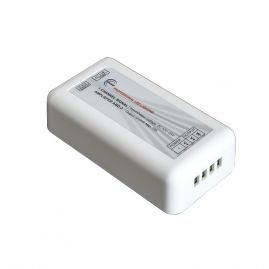
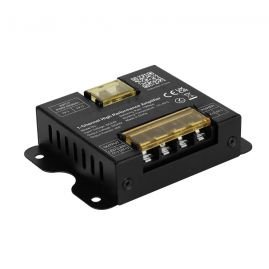
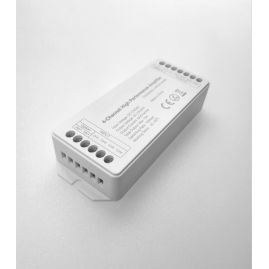
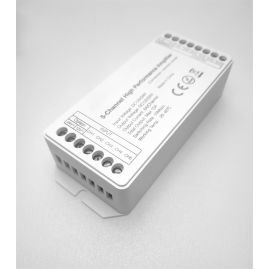
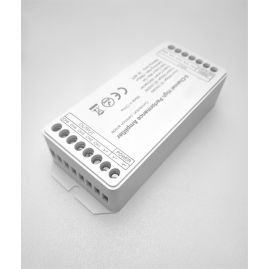
A signal amplifier, or amplifier, is a device designed to restore and transmit a control signal from a controller to the next sections of the LED strip. It works in conjunction with a controller (dimmer or RGB controller) and duplicates its output signal, while powering new sections of the strip from a separate power supply.
Simply put, if you have a long strip and the controller can no longer cope with power and signal transmission, the amplifier solves the problem, ensuring stable brightness and synchronous operation of all segments.
Why do you need a signal amplifier?
The control signal transmitted through wires to the strip (especially RGB or RGBW) loses strength over time and distance. This manifests itself as follows:
- Sections of the tape at the end of the line lose brightness;
- Colors are distorted or start to work asynchronously;
- Control becomes unstable.
This is especially true for:
- RGB and RGBW tapes;
- Systems with dimming;
- Long lines (more than 5 meters per channel);
- Installations with a large number of tapes connected to one controller.
An amplifier allows you to avoid all these problems and expand the capabilities of the light control system.
How does a signal amplifier work?
The operating principle of the amplifier is simple:
- It receives a signal from the controller output (dimmer, RGB controller, etc.) etc.);
- Repeats (duplicates) this signal;
- The second power supply unit connected to the amplifier provides the required power;
- The signal and power are transmitted to the next section of the tape.
Thus, the controller controls several sections at once, but is not overloaded, since the amplifier takes power from its circuit, and not from the main controller.
What types of signal amplifiers are there?
There are several types of amplifiers, differing in functionality and the type of supported tapes:
1. For single-color tapes (monochrome)
Support brightness control of one line (for example, a white tape). They are used in systems with dimming or with long backlighting.
2. For RGB and RGBW strips
Work with three or four channels: red, green, blue and white. Support RGB controller signal repetition and allow you to connect additional strip sections with precise color synchronization.
3. For CCT strips
Control four or more channels (add white or adjustable color temperature). With dynamic effects. These are more complex devices that require precise matching with the controller.
4. With increased load capacity
Some models support loads up to 30 amps. Such amplifiers are necessary in professional installations and commercial facilities.
How to properly connect a signal amplifier
Connecting an amplifier — is not a difficult task, but it requires following certain rules:
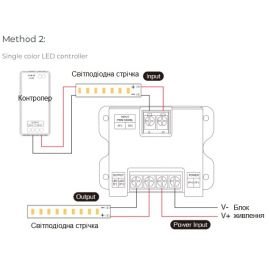
- Connect the controller output to the amplifier input. Usually these are signal wires: V+, R, G, B, etc.
- Connect a separate power supply to the amplifier. It should match the voltage and power of the additional strip.
- Connect the next section of the strip to the amplifier output.
Important: the voltage of all power supplies (controller and amplifier) must match - either 12V or 24V. It is also necessary to observe the polarity.
How to choose a signal amplifier for an LED strip
1. By voltage
Most strips operate on 12V or 24V. The amplifier must exactly match this parameter.
2. By strip type
- For single-color - a mono amplifier is enough;
- For RGB, RGBW - choose an amplifier with the required number of channels.
- You can use RGBW amplifiers for RGB strips. Just do not use the W channel.
3. By power
Calculate the power of the connected strip (W/m × length) and choose an amplifier with a reserve of 20-30%. Pay attention to the maximum permissible current (for example, 4 channels of 5 A = 20 A).
4. By compatibility with the controller
Choose an amplifier that is compatible in terms of signal protocol and control. This is especially important when using intelligent systems (SPI, Dali, DMX, etc.).
Advantages of using an amplifier
- Connecting long sections of tape without losses;
- Maintaining brightness and color along the entire length;
- Synchronous operation of RGB/RGBW sections;
- Reducing the load on the controller;
- Flexibility of the system — can be scaled without re-planning the entire chain.
Installation Tips
- Use amplifiers every 5-10 meters of RGB strip;
- If necessary, use several amplifiers in different zones;
- Install power supplies closer to the amplifiers to minimize losses;
- Make sure there is ventilation - powerful amplifiers can heat up;
- Do not connect the outputs of different amplifiers together.
Conclusion
A signal amplifier for LED strip is an indispensable device in systems that require stable, bright and synchronous lighting over long distances. It ensures uninterrupted operation of long strips, maintains color accuracy and extends the service life of the equipment. A properly selected and connected amplifier - this is a guarantee of professional quality lighting both in the interior and on facades, display cases or exhibitions.