DMX, SPI and DALI Controllers: LED Lighting Control System
Modern lighting has long gone beyond the simple “on/off” function. Today, thanks to the development of digital technologies, LED control has become intelligent and flexible. In this context, DMX, SPI and DALI controllers play a special role - systems that allow for precise, synchronous and automated light control. In this article, we will consider the differences between these controllers, where they are used and how to choose the right solution for specific tasks.
What are controllers and why are they needed?
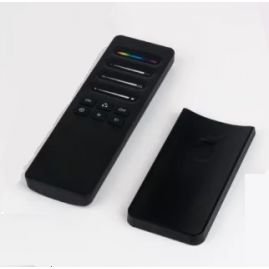
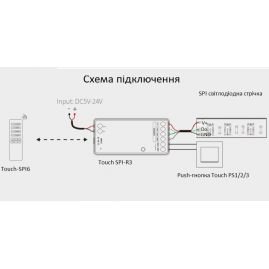
Controllers — these are devices that receive signals from a control source (remote control, computer, smart home system) and transmit commands to LED devices: turn on, turn off, change brightness, color, effect, etc.
Thanks to them, you can:
- Create lighting scenarios and animations;
- Centrally control a large number of lighting devices;
- Increase energy efficiency;
- Integrate lighting into a "smart home" or industrial automation.
Now let's look at the three most popular standards: DMX, SPI, DALI.
DMX controllers — standard for show and stage lighting
What is DMX?
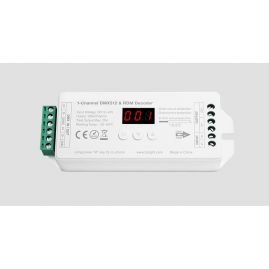
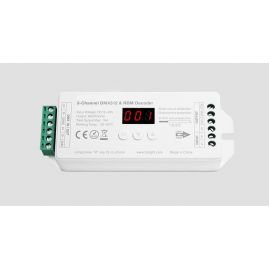
DMX512 (Digital Multiplex) is a professional data transmission protocol designed for controlling stage lighting and effects. One DMX controller can control up to 512 channels, where each channel is this is one function (brightness, color, strobe, etc.).
Application:
- Concerts, stages, clubs;
- Architectural lighting of buildings;
- Light shows and interactive installations;
- Control of RGB and RGBW lamps, spotlights, LED panels.
Advantages:
- Reliability and resistance to interference;
- Scalability - you can combine tens and hundreds of devices;
- Control flexibility - via remote controls, PCs, programmable panels;
- Feedback support in the extended RDM (Remote Device Management) standard.
Disadvantages:
- Requires wiring according to a special scheme (DMX lines);
- Configuration can be difficult for beginners.
SPI controllers - control of pixel strips
What is SPI?
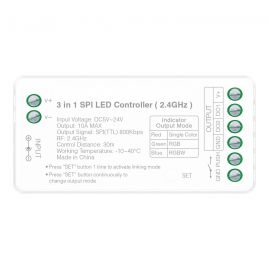
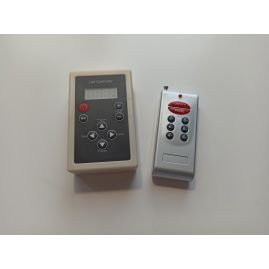
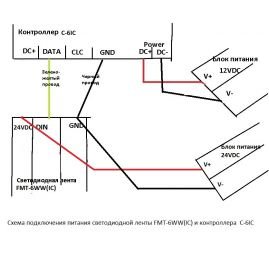
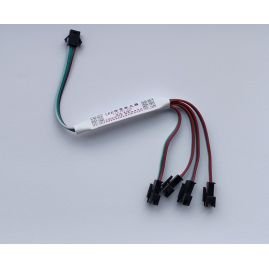
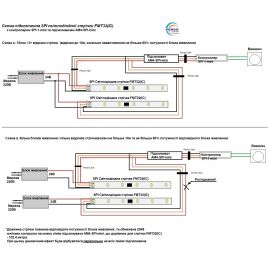
SPI (Serial Peripheral Interface) - is a protocol for controlling digital addressable LEDs (for example, M16703A, WS2812, SK6812, APA102, etc.). Unlike DMX, here each pixel (unit of LED strip) has its own address and can be individually controlled.
Application:
- LED strips - "running lights"
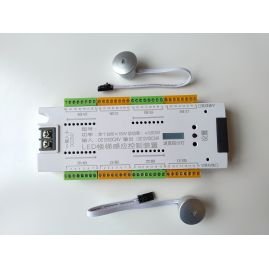
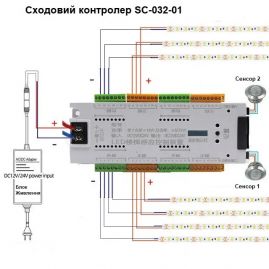
- Dynamic lighting of stair steps
- LED screens;
- Decorative media facades;
- Dynamic signs;
- Pixel garlands and matrices.
Advantages:
- Individual control of each unit of LED strip;
- Ability to play complex animations and dynamic effects;
- Controllers often work with memory cards, USB or via PC;
- Wide compatibility with various chips and LED strips.
Disadvantages:
- Dependence on the type of LED chip used;
- Large systems require signal amplification and well-thought-out architecture.
DALI controllers - intelligent lighting of buildings
What is DALI?
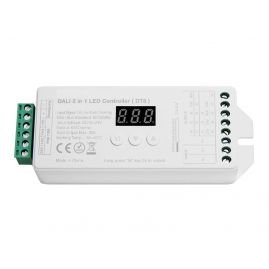
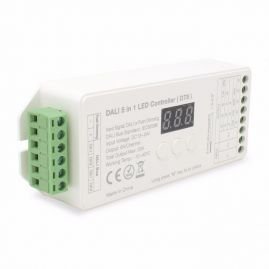
DALI (Digital Addressable Lighting Interface) is a protocol designed to control lighting in buildings, including office, residential and industrial buildings. Each device has a unique address, and the system supports two-way communication - the lamp can transmit data back to the controller (for example, about a malfunction).
Application:
- Smart lighting in offices, hotels, business centers;
- Integration with BMS (Building Management System);
- Energy-efficient solutions for large buildings;
- Control of brightness, scenarios, motion and illumination sensors.
Advantages:
- Two-way communication and equipment status monitoring;
- Support for up to 64 devices on one line;
- Simple network topology — no strict connection sequence;
- Compatible with sensors, timers, control panels.
Disadvantages:
- The data transfer rate is lower than that of DMX;
- The cost of components is higher;
- More complex integration with RGB/RGBW LEDs (not convenient in all cases).
How to choose the right controller?
The choice depends on the purpose and tasks:
- For light shows, architectural lighting, RGB spotlights — it is better to use DMX.
- For dynamic LED animation and pixel screens — SPI is ideal.
- For office lighting control, with sensors, scenarios and energy saving — your choice of DALI.
Also consider compatibility with light sources, installation requirements and supported protocols.
Conclusion
DMX, SPI and DALI controllers are three different approaches to lighting control, each tailored to specific tasks. The choice of protocol determines the flexibility, scalability and ease of control of your LED system. Understanding the differences between these technologies will help you choose the optimal solution - whether it is creative lighting, office lighting or complex multimedia installations.