Infrared Switch for LED Strip Lights: Convenience, Technology, and Choice
LED strips have become an integral part of modern life, thanks to their energy efficiency, aesthetics, and ease of installation. To make lighting control even more convenient and functional, infrared (IR) switches are increasingly used. These are devices that allow you to turn the light on and off without physical contact - just by waving your hand or by approaching.
In this article, we will consider how an infrared switch works, what its advantages are, and how to choose the right model for your LED strip.
What is an infrared switch?
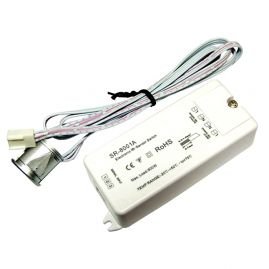
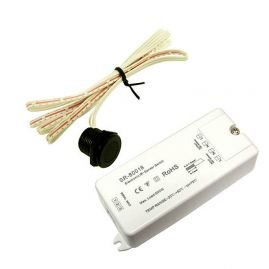
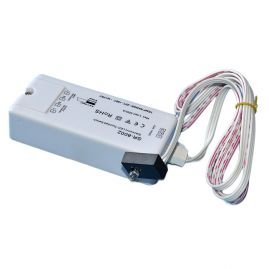
An infrared switch is an electronic device equipped with a sensor that responds to movement in the infrared radiation zone. It is usually activated when an object (a hand or a human body) crosses an invisible infrared beam. Depending on the design, the switch can either:
- be triggered by a single gesture, turning the strip on/off,
- turn on the light in the open position and turn it off in the closed position
- or react to approaching and holding, turning on the light for a specified time.
IR switches are often used in LED systems, as they provide contactless and hygienic control.
How an infrared sensor works
Infrared sensors work according to the following scheme:
- The device emits an infrared beam;
- When an object enters the beam's range, the reflected signal is captured by a photodetector;
- The microcontroller recognizes the change and transmits a command to turn the power on or off strips.
IR switches operate on the basis of active infrared technology, which means that both the emitter and receiver are in one housing.
Where is an infrared switch for LED strips used?
IR switches are especially convenient in places where access to a classic switch is inconvenient, or where it is important to minimize contact:
- Kitchen sets - backlight turns on with a wave of the hand;
- Wardrobes and cabinets - automatic switching on when the door is opened;
- Mirror lighting - the sensor is built into the mirror itself or the frame.
- Bathrooms and toilets - convenient for wet hands;
- Sleeping areas - sensor at the head of the bed for soft light control;
- Commercial display cases, exhibitions - convenient activation of the backlight.
Advantages of an infrared switch
An IR switch is not just a fashion accessory, but a well-thought-out functional solution that has a number of obvious advantages:
1. Contactless control
No need to look for a switch or press buttons - especially convenient in the kitchen, workshop or at night.
2. Hygiene
No fingerprints, and, most importantly, no contact in sanitary facilities.
3. Convenience and ergonomics
The installation is built into the profile or installed on the surface of the furniture. The control is effortless and intuitive.
4. Energy saving
Some models have an automatic shutdown function by timer or in case of no movement.
5. Durability
No mechanical buttons - less wear, longer service life.
Types of infrared switches for LED strips
There are several types of IR switches, differing in the method of control and installation:
1. Sensors with "wave of the hand" control
The most popular option. Switching on and off occurs with a quick wave of the palm in front of the sensor.
2. Sensors in Door mode
They are installed close to the door surface. If the door is open, the light turns on; if closed, it turns off. Used in cabinets, wardrobes, drawers, kitchen cabinets.
3. Proximity sensors
The light turns on when an object approaches and turns off when it leaves. Used, for example, in small rooms or for backlighting washbasins.
4. With a timer
The IR sensor turns on the light for a set time (for example, 30 seconds, 2 minutes), then automatically turns it off if no more movements are detected.
5. Infrared dimmer switch
Combines on/off and smooth brightness control functions. Usually, the brightness changes when you hold your hand over the sensor.
Technical parameters and selection features
When choosing an IR switch for an LED strip, pay attention to the following characteristics:
✅ Voltage and power
- Compatibility with 12V or 24V LED strips;
- Permissible load power (usually from 36 to 96 W and above).
- Input voltage of 12-24V assumes connection of the switch between the power supply and the LED strip,
- Input voltage of 220V assumes connection between the network and the power supply.
✅ Connection type
- Built-in (for aluminum profiles), contact pads to which the LED strip is directly soldered;
- Remote, with wires or terminals, availability standard connectors (DC 5.5 x 2.1 mm).
- Unique PIR-S1 sensor controls Touch series dimmer receivers(”VERSO”) via radio signal.
✅ Materials and protection
- Housing made of fire-resistant plastic or aluminum;
- Moisture protection (IP44 and above) is especially important for the kitchen and bathroom.
Installation and connection
Infrared switches are usually compact in size and easy to install:
- Inside the aluminum profile — aesthetically pleasing and hidden;
- External installation — can be installed on a flat surface of furniture;
- Connection is carried out according to the diagram:
For 12-24 Volts: Power supply → IR switch → LED strip.
For 220 Volts: IR switch → Power supply → LED strip.
It is important to observe the polarity of the connection and power limitations - excess current can damage the device.
Conclusion
The infrared switch for the LED strip is a modern, practical and hygienic solution for lighting automation. It is suitable for both domestic and commercial use, making light control intuitive and comfortable. Easy installation, long service life and high functionality make such switches a great addition to any LED lighting.
If you want to equip your kitchen, closet or bathroom with truly smart lighting - an IR switch will be the perfect choice.

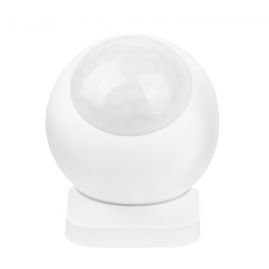
- Load current: wall invoice
- Number of control zones: 1
- Series: Touch